The Working Mechanism for Consultation and Coordination on India-China Border Affairs (WMCC) was established in 2012 as an institutional mechanism for consultation and coordination for the maintenance of peace and tranquillity in the border areas.

He said there were no signs of an "overt collusion" between China and Pakistan during the Ladakh standoff but India also caters to a long term strategy for not a two, but a two-and-half front war. With the half front, he was referring to the internal security.

The remarks of White House Press Secretary Jen Psaki came ahead of the 14th round of military-level talks between India and China on the 20-month row in eastern Ladakh.
'The two sides should support rather than undermine each other, strengthen cooperation rather than guard against each other, and enhance mutual trust rather than be suspicious of each other'

With the two armies again in a face-off at multiple points, there is apprehension of renewed clashes.

The army made the comments as part of a statement trashing a media report that said the Chinese military has again crossed the Line of Actual Control in eastern Ladakh at several places and that there has been at least one incident of clash between the two sides.
Gen Naravane said India is dealing with China in a "firm" and "non-escalatory" manner to ensure the sanctity of its claims in eastern Ladakh, and that it was even open to initiating confidence-building measures.

A village built by China along the Line of Actual Control in the Arunachal Pradesh sector and mentioned in a recent Pentagon report, is in territory controlled by that country, sources in the security establishment in New Delhi said on Tuesday.
It is learnt that the face-off took place after a Chinese patrol tried to enter Indian territory and the troops of China's People's Liberation Army were forced back.
India and China on Tuesday agreed to hold the next round of the Senior Commanders meeting at an early date to achieve complete disengagement from all friction points in eastern Ladakh to create conditions for the restoration of normalcy in bilateral ties.

The discussions took place on the sidelines of the G20 Foreign Ministers' Meeting.
A day after the nearly 13-hour meeting, the two sides in a joint statement on Saturday reaffirmed that such a resolution would help restore peace and tranquillity along the Line of Actual Control (LAC) in eastern Ladakh and facilitate progress in bilateral relations.
"On the border issue, China always maintains that we should follow through on treaties and agreements we signed and we jointly uphold peace and tranquility at the border region," Foreign Ministry spokesman Wang Wenbin said while responding to Jaishankar's remarks.

China on Tuesday announced that its Defence Minister General Li Shangfu will visit India this week to attend the meeting of SCO defence ministers from April 27 during which he is expected to hold talks with his Indian counterpart Rajnath Singh on ending the prolonged eastern Ladakh standoff which has severely strained bilateral ties.
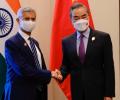
External Affairs Minister S Jaishankar on Thursday conveyed to his Chinese counterpart Wang Yi the need for an early resolution of all outstanding issues along the Line of Actual Control in eastern Ladakh, and asserted that bilateral ties should be based on mutual respect, mutual sensitivity and mutual interest.
"Against such background, the words and deeds of relevant important military and government officials and military deployments should be conducive to deescalating and cooling down the situation, and to enhancing mutual trust, rather than the opposite", the spokesman said.

India and China are likely to hold another round of diplomatic talks this week on eastern Ladakh with a focus on moving forward in disengagement of troops in the remaining friction points, people familiar with the development said on Tuesday.
India and China on Friday agreed to hold the next round of military talks at an early date to achieve the objective of complete disengagement in remaining friction points in eastern Ladakh amid fresh sparring between the two sides on the prolonged Line of Actual Control (LAC) standoff.

He said if the Chinese military maintains the deployment through the second winter, it may lead to an LoC-like situation (Line of Control) though not an active LoC as is there on the western front with Pakistan.

Replying to clarifications sought by MPs in Rajya Sabha on his statement on the border row, the minister said skirmishes and face-off with China in the last few months have been primarily over the issue of patrolling the Ladakh border.

'India's behaviour violated agreements...It's a serious military provocation'

After India firmly told China that its violation of the border pacts has "eroded" the entire basis of bilateral ties, China's defence ministry on Friday said the situation at the border is "generally stable" and both sides should put the boundary issue in an "appropriate position" and promote its transition to "normalised management".

Wang began a two-day trip to Pakistan on Tuesday primarily to attend a meeting of the Council of Foreign Ministers of the Organisation Islamic Cooperation (OIC) as a special guest.
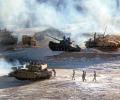
There was no visible forward movement in disengagement of troops in the remaining friction points as the Chinese side did not show flexibility in their approach on it at the 11th round of military talks.
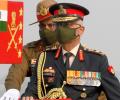
The Army Chief replied in the affirmative when asked by the moderator whether he concurs with Prime Minister Narendra Modi's remarks after the border standoff that the Chinese have not come into control of Indian territory.
'India cannot allow Beijing's policy of stabilising and destabilising the border at will to perpetuate its own ends.' A riveting excerpt from Manish Tiwari's 10 Flashpoints; 20 Years National Security Situations That Impacted India.
The talks till now have resulted in the resolution of issues in North and South Bank of Pangong Tso, Galwan and Gogra Hot Spring areas.
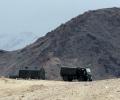
Singh also said that India will give a befitting reply to anyone threatening its unity, sovereignty and territorial integrity as it no longer remained a "weak" country.
China routinely objects to Indian leaders' visits to Arunachal Pradesh to buttress its stand.
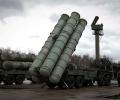
RInstead of disengagement, the Indian and Chinese armies have deployed an estimated 35,000 to 40,000 soldiers each along the LAC. The PLA has deployed S-400 air defence missiles to neutralise the IAF's advantage in air power

In a major boost to its fire power, the Indian Army has deployed a sizeable number of upgraded L70 anti-aircraft guns in the high mountains along the Line of Actual Control in Arunachal Pradesh in addition to its existing M-777 howitzers and Swedish Bofors guns, officials said on Wednesday.

It has been argued that India should have held back on disengagement from the Kailash Range, using that as a trump card to force Chinese concessions in areas such as Depsang, where they hold the advantage.

The India Army troops rose to the occasion to the challenges along the northern border as likely contingencies and possible options were war-gamed beforehand, Army Chief Gen M M Naravane said on Wednesday, referring to the eastern Ladakh standoff with China.
"The meeting thus did not result in resolution of the remaining areas," the Army said in a statement.

Launching his three-day tour of Tamil Nadu ahead of the April 6 assembly polls, the Congress leader, while interacting with advocates, reiterated his "hum do hamare do" jibe at the ruling dispensation at the Centre.
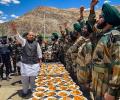
Defence Minister Rajnath Singh on Monday said India is a peace-loving nation that never resorts to any kind of aggression but is always prepared to give a befitting reply if provoked or threatened.
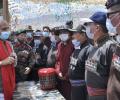
The dedication of Indian soldiers and veterans towards the country is an 'exemplary example', Defence Minister Rajnath Singh said on Sunday soon after arriving in Ladakh on a three-day visit aimed at taking stock of India's military preparedness in the region in the face of a prolonged border row with China.

"Our patience is a sign of our self-confidence, but no one should make the mistake of testing it," Gen Naravane said.

The nearly five-minute video captured glimpses of the lives of soldiers deployed along the ice-capped mountains of the high-altitude region including their round-the-clock vigil, training and combat readiness to deal with any threat.

Chinese President Xi Jinping, who made a rare visit this week to the restive Xinjiang region which borders Ladakh, met the troops and officers stationed there and praised their "outstanding contributions" to the border defence and stabilisation of the volatile province.
 © 2026 Rediff.com - Advertise with us - Disclaimer - Privacy Policy - Sitemap - Feedback - About us - Terms of use - Grievances